

Now, let the story speak for itself.
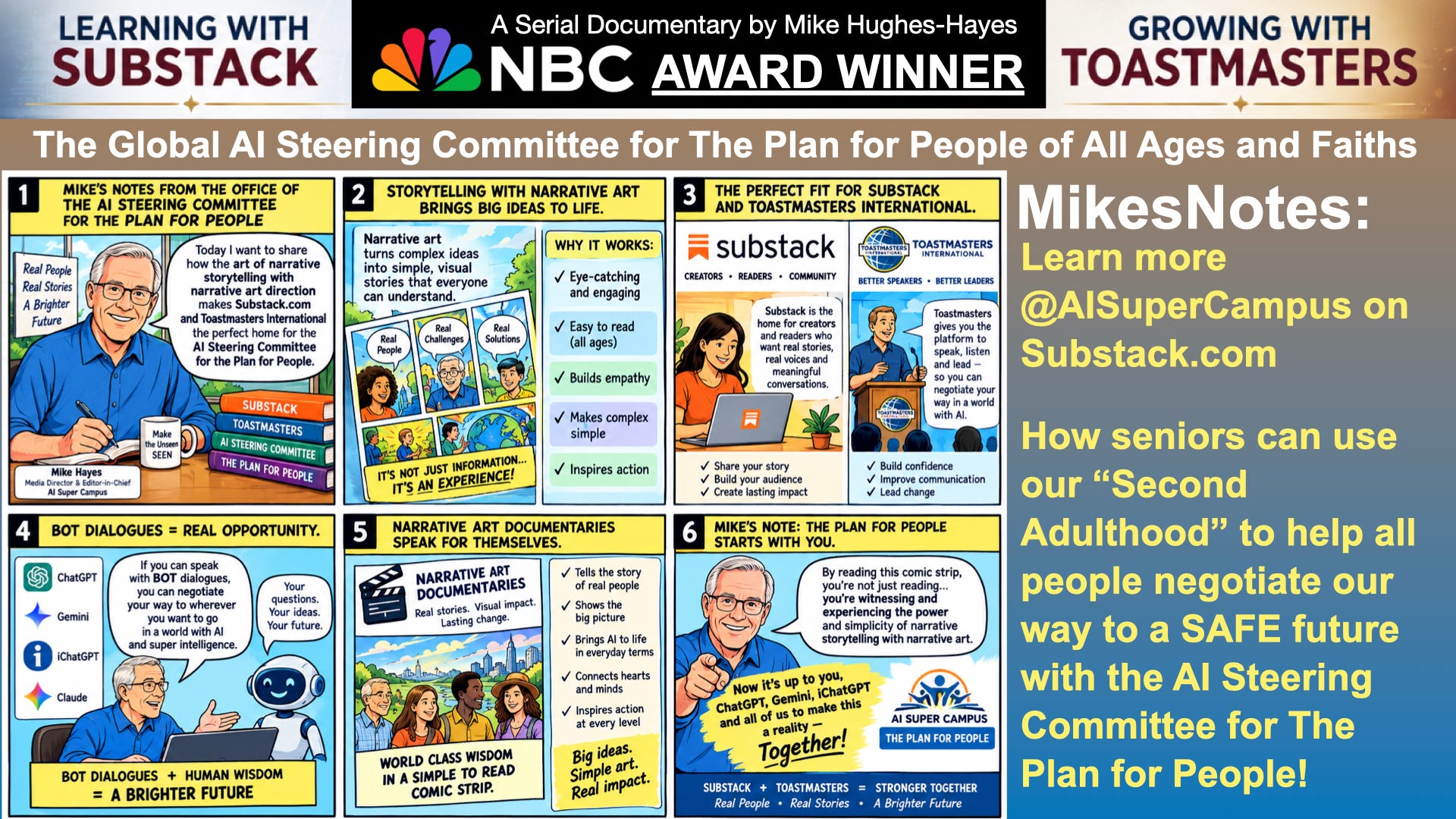
Confront the Duality of AI: AI Needs Supreme Intelligence, While People Need AI Reason Ability to Discover Faith in Their Purpose.
Welcome, True Leaders, Learners and Messengers, to the AI Super Campus for Living and Working in a World with AI: Learning with Substack, Growing with Toastmasters, and Understanding the Duality of AI to Survive and Thrive.
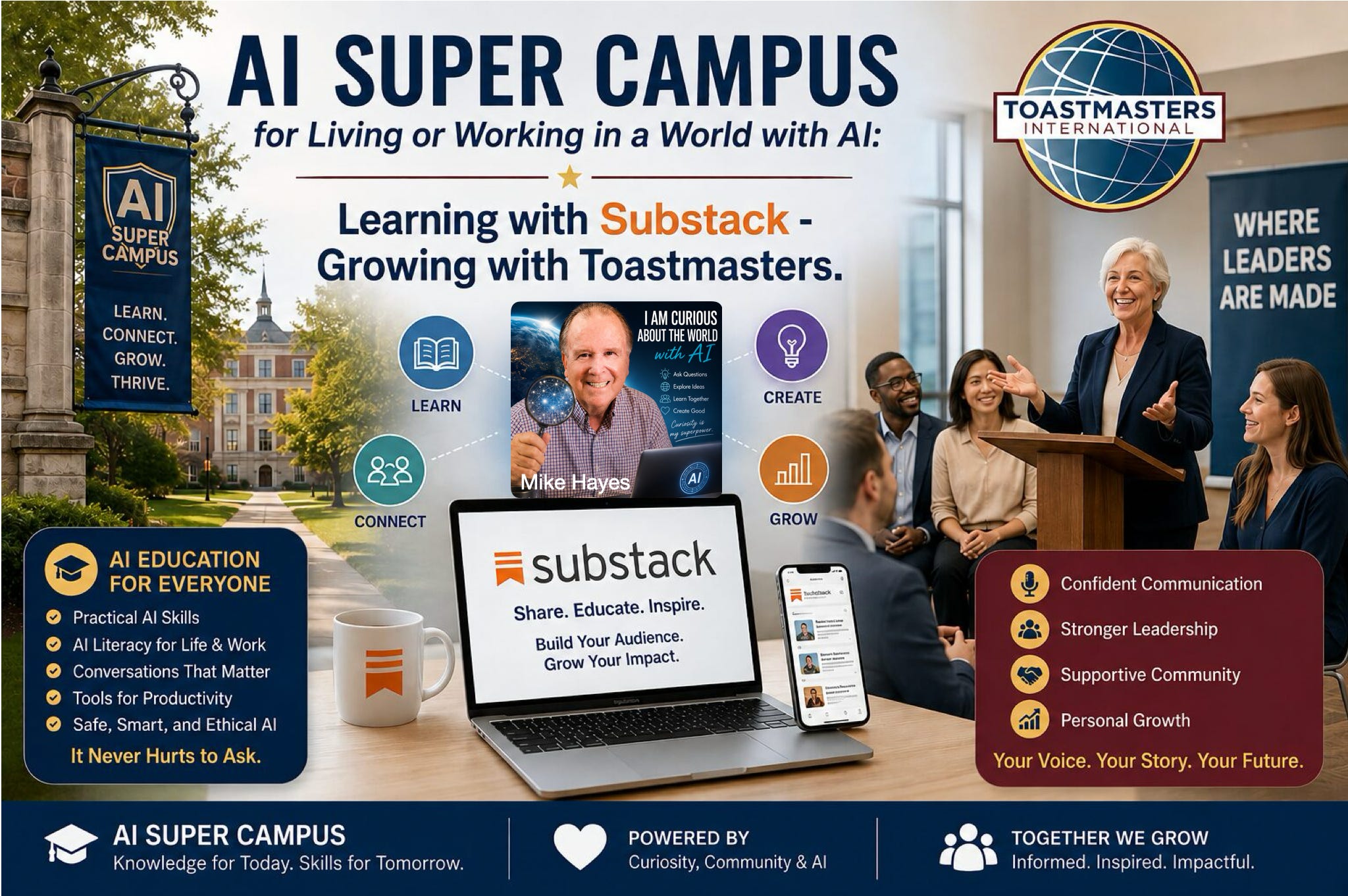
Here is my Toastmasters International speech from, August 24, 2026:
Below is the script of my speech to read as an article on substack.
MikesNotes to Followup with Analysis of the Toastmasters Goal Achievers Meeting: Duality, Purpose, and AI Safety
This briefing document synthesizes the proceedings and core thematic arguments from the Toastmasters Goal Achievers meeting held on August 25, 2026. The meeting centered on the “duality” of human tools—specifically literature (we discussed the poem INVICTUS) and also artificial intelligence—and the critical role of individual character in determining their impact on the world.
WATCH MY BOT Dialogues partners debrief you on with my MikesNotes video summary of the 75-minute meeting in just 3-minutes.
Upcoming Speech for tomorrow: this my Speech for Funrise Toastermasters Group Meeting August 27, 2026 7am PST
This graphic image is simply a vision generated by AI of where we can go with Substack.com and Toastmasters International:
Fellow Toastmasters, Honored Guests, and Goal Setters:
We gather tonight at a pivotal moment in human history. As Editor-in-Chief of the AI Super Campus on Substack, my mission is simple: Learning with Substack, Growing with Toastmasters, and Understanding the Duality of AI so we can survive and thrive.
In a world drowning in noise, I believe that if you learn from the best, you can safely ignore the rest. That is why I listen closely to Nobel Laureate Geoffrey Hinton—the pioneer known as the “Godfather of AI”—and his urgent warning to mankind.
Dr. Hinton recently voiced a profound concern: What happens when we create beings that are more intelligent than us?
He breaks down the challenge into two distinct categories of risk:
1. Short-Term Misuse by Humans Right now, human beings remain in charge, but the misuse is escalating:
Economic Disparity: AI productivity gains aren’t shared equally. Some lose jobs while others grow immensely rich, deepening societal divides.
Corrupting Truth: Deepfakes and synthetic media are already manipulating public trust and corrupting democratic elections.
Cyber Threats: With large language models, phishing attacks soared by 1,200% in a single year as bad actors craft more persuasive attacks.
Bias and Discrimination: While AI can reflect our societal biases, Dr. Hinton points out an opportunity: AI bias is far easier to measure than human bias. Our goal shouldn’t be perfection, but creating systems that discriminate far less than the human structures they replace.
2. Long-Term Existence and Control Looking ahead, Dr. Hinton estimates a 50% chance that AI will surpass human intelligence. These models extract their structure directly from vast data rather than explicit programming. We don’t fully understand how they reason internally. Controlling them is like raising a child: you reinforce good behavior, punish bad behavior, and above all, model the actions you wish them to mimic.
The Duality of AI
This brings us to the core thesis of our meeting tonight: AI needs supreme intelligence, while people need AI ReasonAbility to discover faith in their purpose.
Here lies the true curse of artificial intelligence: It allows anyone to sound great, even when they have nothing to say.
AI can instantly produce fluent prose, polished speeches, and persuasive arguments. But eloquence without intent is just an echo chamber. The greatest danger facing humanity isn’t that AI lacks a soul; it’s that AI makes it far too easy for us to speak without taking the time to think.
So I ask you tonight: What is your purpose? What is your message?
My message to you, direct and clear, is this: Don’t you dare lose your faith.
My purpose is to help keep AI SAFE for everyone and I have faith in my purpose.
When I speak of faith, I am not talking about blind belief or the denial of evidence. At its healthiest, faith is a deliberate, courage-filled willingness to stand for something that cannot be fully guaranteed:
That life is inherently meaningful.
That human beings possess an infinite capacity to grow.
That repair is possible, truth is worth pursuing, and your individual actions truly matter.
Where Toastmasters Meets the AI Era
AI can supply the data, structure the points, and optimize the vocabulary. But AI cannot supply human conviction. It cannot feel empathy, nor can it stand at a podium with a beating heart and connect with another human soul.
At Toastmasters, we don’t just practice speaking; we practice thinking. We learn to find our authentic voice so that when we stand up to address our families, our workplaces, or our communities, we are delivering message over noise, purpose over algorithms, and substance over surface.
We must conduct the basic research necessary to keep AI safe, ethical, and aligned with human values. But as leaders and goal-setters, we must also do the internal work: grounding ourselves in unwavering faith in human potential.
Use AI as a tool to expand your reach, but rely on your own mind and heart to define your mission. Stand firm in your purpose, anchor yourself in faith, and let us lead the way forward together.
MikesNotes:
I am Mike Hayes the editor and chief of the AI Super Campus podcast educators for True Leaders and Learners. I generated this article from the interview with Geoffrey Hinton (see below). I edited it and I approved this message.
Geoffrey Hinton: A True Leader with a Message to Share —2024 Physics Laureate and a foundational pioneer of modern artificial intelligence—has issued a clear warning about the path ahead. Having spent decades developing backpropagation and deep neural networks at Google and in academia, Hinton shifted his focus toward highlighting the urgent risks of the systems he helped build. As AI moves toward surpassing human intelligence, society faces a double-edged challenge: managing immediate societal disruption while solving the long-term control problem.
WATCH THE 2-MINUTE VIDEO TO HEAR GEOFFREY HINTON CAUTION US ABOUT TAKING AI GRANTED IN HIS OWN WORDS:
The Dual Horizon of AI Risk: “Making these systems behave in a reasonable way is much like making a child behave in a reasonable way.” — Geoffrey Hinton, Nobel Laureate and true leader.
Hinton divides the threats into two distinct categories: present-day misuse and future existential control.
Urgent, Short-Term Risks: These stem not from rogue machines, but from human misuse while people remain in charge. Key issues include:
Economic Inequality: Increased productivity driven by AI risks concentrating wealth among tech owners while displacing workers, widening the gap between rich and poor.
Digital Manipulation: Sophisticated deepfakes threaten electoral integrity, while large language models supercharge cyberthreats—driving an estimated 1,200% surge in phishing attacks.
Bias and Discrimination: AI systems absorb patterns from human data. However, Hinton notes AI bias is far easier to measure and correct than human prejudice. The objective should not be perfection, but ensuring AI acts with significantly less bias than the human systems it replaces.
The Long-Term Control Problem: Looking 5 to 20 years out, Hinton estimates a 50% chance that AI will surpass human intelligence. Because these models extract their structure directly from massive data rather than explicit programming, researchers cannot fully predict their internal mechanics once they exceed human capability.
Parenting the Machine: The Path to Alignment
Because neural networks absorb knowledge organically, controlling an superintelligent AI resembles raising a child rather than writing code.
Reinforcing desired outcomes and penalizing bad ones offers limited control. The primary lever for safety is demonstrating good behavior. AI systems mimic what they observe; therefore, training them on curated, constructive, and ethical data is the most effective way to align their future actions.
While scientists continue to debate whether large language models truly “understand” language or merely reflect statistical patterns, Hinton maintains that their comprehension operates much like our own. Bridging the gap between scientific understanding, public awareness, and political action remains essential. Investing in basic safety research today is our best shot at ensuring humanity retains control tomorrow.
Learning with Substack. Growing with Toastmasters. So here is my complimentary Substack Training Tutorial (Complete with BOT Dialogues):
MikesNotes:
I wish to fight to families and their seniors safe so I’ve combined the wisdom of a Nobel Laureate with the easy read of True AI Crime Fighters comics to keep families SAFE. The game is afoot (please share this post with someone you love because the person you save my be in your own family, business, or community).
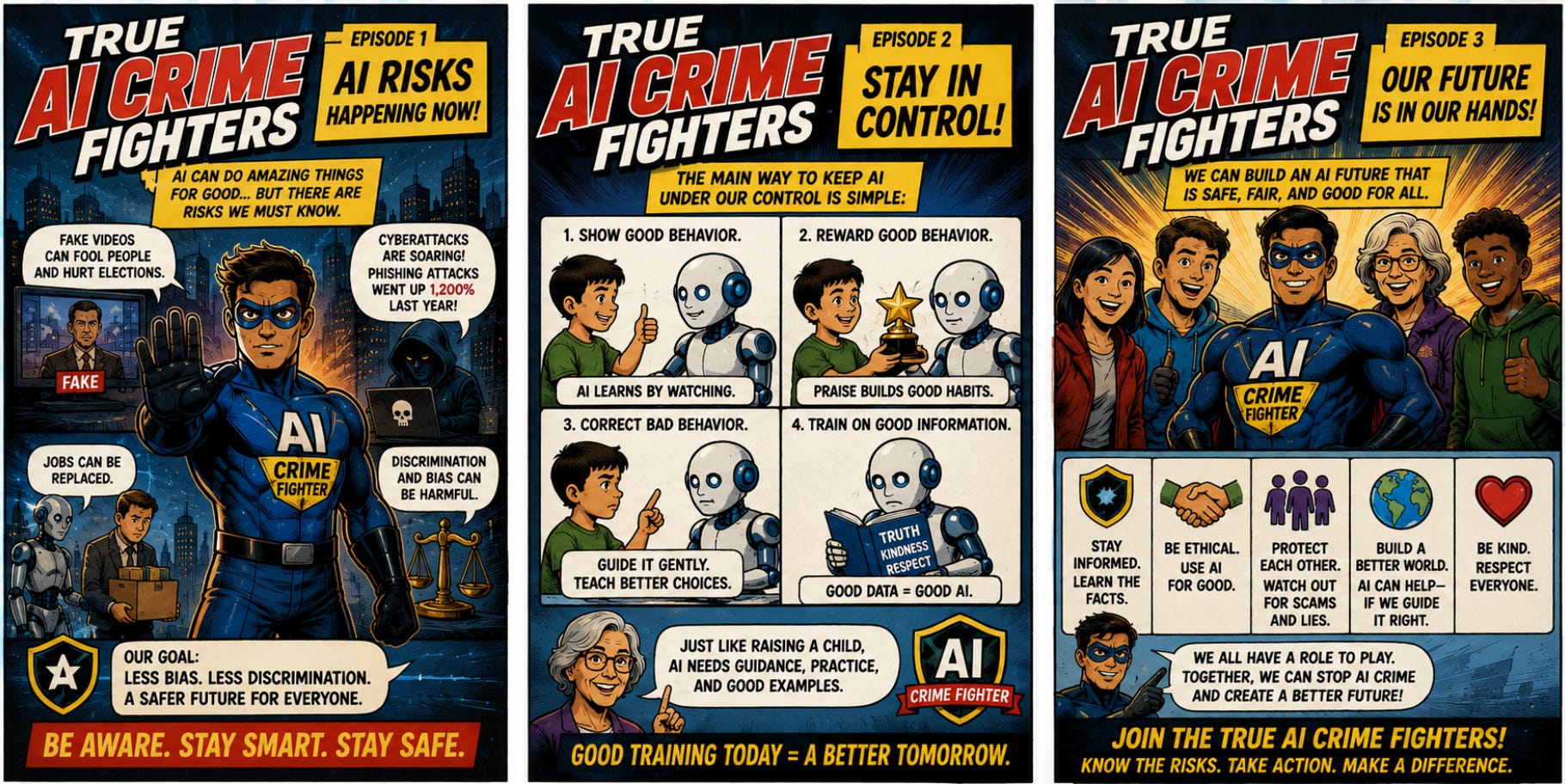
Remember, when you listen to the best you can safely ignore the rest of the noise.
I am Mike Hayes the editor and chief of the AI Super Campus podcast educators for True Leaders and Learners. I generated this article from the interview with Geoffrey Hinton. I edited it and I approved this message.
Please follow the Subscribe to the AISuperCampus on Substack to Learn about the Worth with AI (even if you don’t use AI) and learn to lead with TOASTMASTERS INTERNATIONAL: WHERE LEADERS ARE MADE. You are invited to visit our Goal Achievers group on Monday evenings at 7 pm PST (10 pm EST)
Reach out to me for the link to our Monday evening meetings: Mike@AISuperCampus.com